While sitting on our verandah enjoying a leisurely Sunday morning, my
husband and I spotted a small group of birds gliding slowly through the
bushland and alighting on trees every few metres or so. As they
gradually came closer and closer, we were intrigued to find out exactly
what these birds were as neither of us had ever seen anything like them
before. They had the most beautiful striped chest and I thought they would make most appropriate subjects for a WOW post.
Of course, I hastily rushed inside to grab my
camera to get a few shots and luckily they were interested in hanging
around for a while before slowly flying off into the distance. After
they had gone, we got out our trusty bird identification book and found
out they are called the Pacific Baza or Crested Hawk.
Aviceda subcristata, or Crested Hawk, have a distinctive slim black crest on a grey head. They are the only Australian hawk that has a crest.
They also have rather large, piercing, bright yellow eyes.
Their white
breast has dark-brown bars all over it while their long tail has dark
bars.
It's thought that they form permanent pairs and are often found in the company of their mate. Occasionally they can be in a small family group and I think that was the case with this group of four birds. It certainly appeared to me to be a family of older birds and juveniles.
Apparently the mating flight display of these hawks is quite spectaular. They soar and circle up to great heights and then swoop and tumble down. Unfortunately we were not privileged with any such display. They were simply cruising the neighbourhood and were gone within twenty minutes. I do hope we get to see them again!
Please do drop by and visit my other blog: My Dry Tropics Garden ... it provides a more informative look at what's going on in my garden out in the bush.
Wednesday, July 13, 2011
Monday, July 11, 2011
Mosaic Monday ... Not Everything Is Black And White
No indeed, not everything in life is black and white. Black and white are not always common sights in anyone's garden either. I did, however, find a little bit of black and white in my garden last week.
Can you spot the black Spangled Drongoes sitting the White Gum?
Now here's a beautiful white. It's the first bloom on my Dietes.
Here's the Spangled Drongo up close. I've been seeing quite a few of them around my place lately. They have a distinctive long forked tail and red eye.
Last of all I'm highlighting the magnificent white Poplar Gums that surround my place.
For lots of terrific Mosaic Monday posts, go and visit Mary at Little Red House
Can you spot the black Spangled Drongoes sitting the White Gum?
Now here's a beautiful white. It's the first bloom on my Dietes.
Here's the Spangled Drongo up close. I've been seeing quite a few of them around my place lately. They have a distinctive long forked tail and red eye.
Last of all I'm highlighting the magnificent white Poplar Gums that surround my place.
For lots of terrific Mosaic Monday posts, go and visit Mary at Little Red House
Friday, July 8, 2011
A Flower Flaunt on this mid-Winter Skywatching Friday.
July is our mid-Winter month and the weather has turned rather warm. We're not getting the cool nights we were around a fortnight ago and the days have warmed up a notch too. The daytime skies have been mostly cloudless and bright blue.
The early morning sunrises and evening sunset skies have been stunning. This was the sunrise viewed from my verandah just this week ....
... and this was the early evening sky on the very same day. Such fantastic colour!
I've recovered enough from the seemingly endless battle with some nasty virus I had picked up recently to finally get out to do some of the much needed clearing out and trimming back. I have to admit that the poor Shadehouse/Greenhouse Garden looks like a huge mess! Some crazy lady has been in there unmercilessly hacking and yanking in between bouts of uncontrollable coughing and spluttering.
I've managed to create the same sort of chaos and mess out in the tiered front garden bed as well, but I made some lovely unexpected finds out there.
Around two years ago I planted two lovely Kalanchoe blossfeldianas ... each in a different tier. They both struggled. I kept breaking off bits and shoving them in the soil, hoping one of the slips would take. I don't know how, given just how much water rushed through this whole area of the garden during the 'wet' season, but one of the slips has rooted and grown and it's just beginning to bloom!!! Wonder of wonders. Look at this hardy little thing! I almost trampled on it in the midst of my tidying frenzy, but my surprising little survivor is intact.
Right behind this little trooper, one of the red Salvia splendens I had planted in the top tier suddenly made a re-appearance as well. Don't you love it when plants seemingly rise from the dead?
But there was more! About a year ago, Hubbie gave me a piece of a plant that was growing in the garden beds at his workplace. He'd thought I would like it a lot and had pulled out a piece to bring home. I just shoved it in a spot on the middle tier and promptly forgot about it, not expecting it to do anything really as hubbie had just yanked the poor thing out without much consideration about actually leaving roots on it.
I hadn't really noticed it in amongst the ferns that had taken over, and just like the Kalanchoe, I was not expecting it to survive the river of water that swept over the tiers for weeks and weeks. But ... guess what! Here's another of my lovely surprises this week.
It's my first ever Dietes bicolor bloom. Isn't it a stunner? Well, I think it's Dietes bicolor, although those petals are definitely not pale yellow. People who read my blog regularly know just how much I love white in my garden, so I'm over the moon with the colour of this eye-catching beauty.
Out in my Courtyard Garden I found another surprise this week. I've had a Tree Begonia sitting in a pot under the pergola for some time now. It's been knocked over by wallabies that like to come into the sheltered pergola area for a snooze. It's had its' arching branches broken off by dive-bombing Kookaburras coming in to drink at the pond. It's been ignored ... by me ... and given very little attention aside from the infrequent watering when I finally remember it's there. Well, I certainly noticed it the other day when I saw its' flowers.
Yes ... more lovely white flowers. I do love the foliage as well!
But even that wasn't the end of the surprises this week.
I've had a Strobilanthes dyerianus / Persian Shield for a little while now and it just has not done well. It's been a sickly looking thing ever since I bought it over a year ago. I've moved it ... re-potted it ... tried to keep it moist because I know it doesn't like being dry ... done a little bit of pruning to try to encourage new growth.
Yep, none of these things worked. So, feeling fed up with it after it was really knocked about during the cyclone earlier this year, I hacked it back almost to soil level. It's been sitting at the back of my 'plant hospital' spot out in the courtyard and when I finally starting clearing this area out, this is what I found.
My stunted tiny little Strobilanthes is flowering. The plant itself has just two stems around 15 cms high and there's flower atop both of them! What? When the plant was around a metre high it just kept losing leaves and looked bare and unloveable, but when I hack it down to almost nothing it responds with blooms!!!!!
It's a never-ending challenge figuring out what to do with some plants.
Anyway, now for some of the plants I was fully expecting to be in bloom right now out in the courtyard and are doing what I think they should be doing.
My gorgeous Pelargonium 'Caliente Series' and Impatiens hawkeri / New Guinea Impatiens 'Celebrette Orchid Star'.
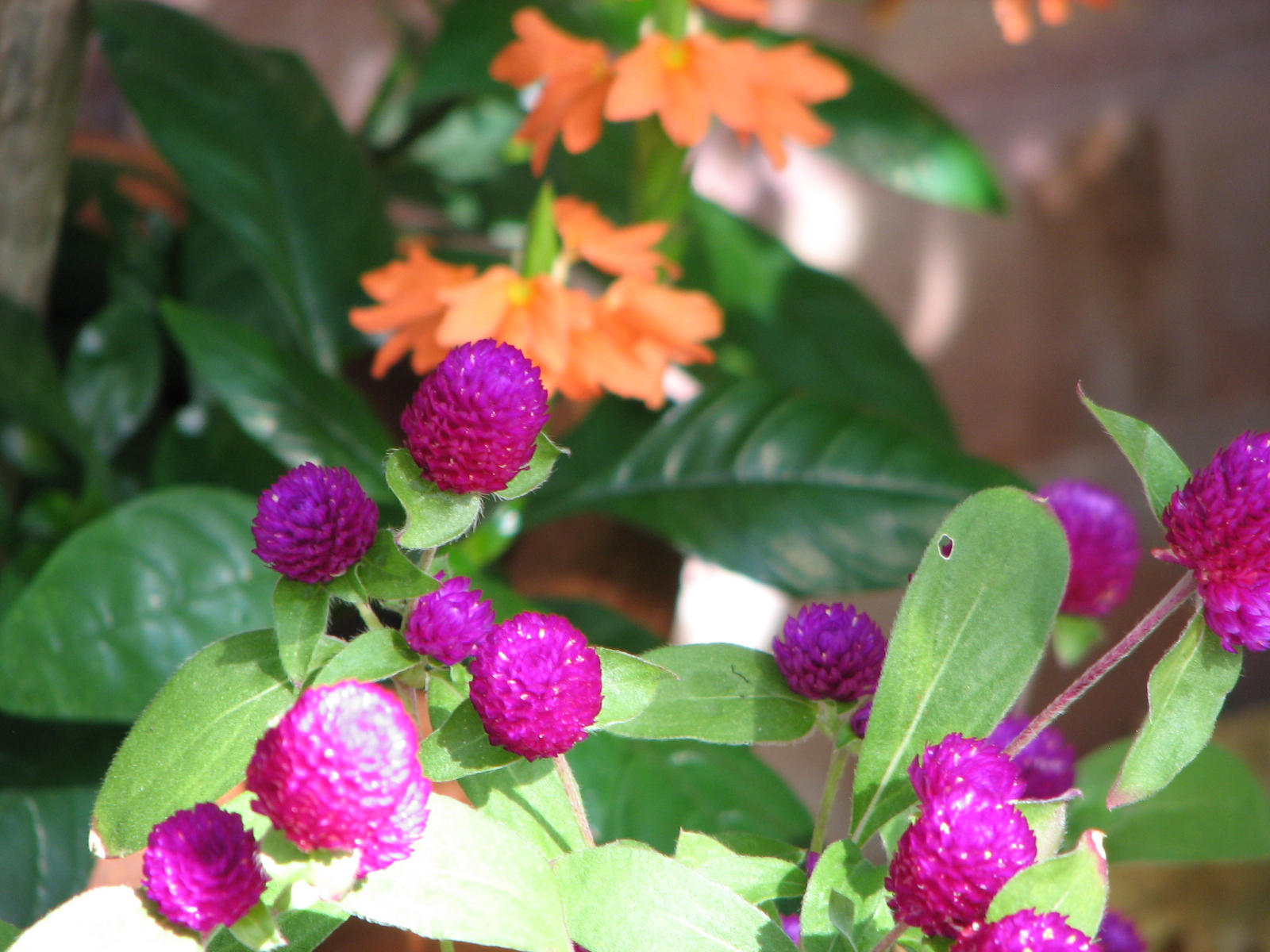
Gomphrena globosa / Bachelor's Buttons and Crossandra infundibuliformis / Firecracker Plant.
More of my Pansies are making an appearance. These are the 'Swiss Super Giants'. This name has to be just wishful thinking, considering their size!
My Spathoglottis or Ground Orchid continues to put out more flower spikes ...
and the double blooms on my Begonia 'Elatoir' are still looking pretty good.
For loads of fabulous posts showing what's in flower around the world, go on over to Tootsie at
and Today's Flowers
The early morning sunrises and evening sunset skies have been stunning. This was the sunrise viewed from my verandah just this week ....
... and this was the early evening sky on the very same day. Such fantastic colour!
I've recovered enough from the seemingly endless battle with some nasty virus I had picked up recently to finally get out to do some of the much needed clearing out and trimming back. I have to admit that the poor Shadehouse/Greenhouse Garden looks like a huge mess! Some crazy lady has been in there unmercilessly hacking and yanking in between bouts of uncontrollable coughing and spluttering.
I've managed to create the same sort of chaos and mess out in the tiered front garden bed as well, but I made some lovely unexpected finds out there.
Around two years ago I planted two lovely Kalanchoe blossfeldianas ... each in a different tier. They both struggled. I kept breaking off bits and shoving them in the soil, hoping one of the slips would take. I don't know how, given just how much water rushed through this whole area of the garden during the 'wet' season, but one of the slips has rooted and grown and it's just beginning to bloom!!! Wonder of wonders. Look at this hardy little thing! I almost trampled on it in the midst of my tidying frenzy, but my surprising little survivor is intact.
Right behind this little trooper, one of the red Salvia splendens I had planted in the top tier suddenly made a re-appearance as well. Don't you love it when plants seemingly rise from the dead?
But there was more! About a year ago, Hubbie gave me a piece of a plant that was growing in the garden beds at his workplace. He'd thought I would like it a lot and had pulled out a piece to bring home. I just shoved it in a spot on the middle tier and promptly forgot about it, not expecting it to do anything really as hubbie had just yanked the poor thing out without much consideration about actually leaving roots on it.
I hadn't really noticed it in amongst the ferns that had taken over, and just like the Kalanchoe, I was not expecting it to survive the river of water that swept over the tiers for weeks and weeks. But ... guess what! Here's another of my lovely surprises this week.
It's my first ever Dietes bicolor bloom. Isn't it a stunner? Well, I think it's Dietes bicolor, although those petals are definitely not pale yellow. People who read my blog regularly know just how much I love white in my garden, so I'm over the moon with the colour of this eye-catching beauty.
Out in my Courtyard Garden I found another surprise this week. I've had a Tree Begonia sitting in a pot under the pergola for some time now. It's been knocked over by wallabies that like to come into the sheltered pergola area for a snooze. It's had its' arching branches broken off by dive-bombing Kookaburras coming in to drink at the pond. It's been ignored ... by me ... and given very little attention aside from the infrequent watering when I finally remember it's there. Well, I certainly noticed it the other day when I saw its' flowers.
Yes ... more lovely white flowers. I do love the foliage as well!
But even that wasn't the end of the surprises this week.
I've had a Strobilanthes dyerianus / Persian Shield for a little while now and it just has not done well. It's been a sickly looking thing ever since I bought it over a year ago. I've moved it ... re-potted it ... tried to keep it moist because I know it doesn't like being dry ... done a little bit of pruning to try to encourage new growth.
Yep, none of these things worked. So, feeling fed up with it after it was really knocked about during the cyclone earlier this year, I hacked it back almost to soil level. It's been sitting at the back of my 'plant hospital' spot out in the courtyard and when I finally starting clearing this area out, this is what I found.
My stunted tiny little Strobilanthes is flowering. The plant itself has just two stems around 15 cms high and there's flower atop both of them! What? When the plant was around a metre high it just kept losing leaves and looked bare and unloveable, but when I hack it down to almost nothing it responds with blooms!!!!!
It's a never-ending challenge figuring out what to do with some plants.
Anyway, now for some of the plants I was fully expecting to be in bloom right now out in the courtyard and are doing what I think they should be doing.
Gomphrena globosa / Bachelor's Buttons and Crossandra infundibuliformis / Firecracker Plant.
More of my Pansies are making an appearance. These are the 'Swiss Super Giants'. This name has to be just wishful thinking, considering their size!
My Spathoglottis or Ground Orchid continues to put out more flower spikes ...
and the double blooms on my Begonia 'Elatoir' are still looking pretty good.
For loads of fabulous posts showing what's in flower around the world, go on over to Tootsie at
I'm also joining Skywatch Friday
and Today's Flowers
Wednesday, July 6, 2011
It's WOW Time ... Wildlife on Wednesday ... Blue-faced Honeyeater.
This beauty is not easily mistaken for any other bird with its striking blue patch around the eyes. Entomyzon cyanotis ... the Blue-faced Honeyeater ... is one of our larger Honeyeaters with golden-green upperparts and a pure white underbody. It has a black crown, a black face and a black neck with a narrow white band across the back.
It is, however, the blue facial skin that really holds my attention. If you look closely, you can see the blue is two-toned, with the lower bit being a really bright cobalt blue.
Just yesterday I had the privilege of witnessing a couple of the Blue-faced Honeyeaters darting here and there amongst the trees here at my place. I do see these lovely birds fairly regularly but this time I was lucky enough to get the song of one of them on record.
The Blue-faced Honeyeater in the video clip is a juvenile. You can tell because this bird's facial skin is a yellow-green. This is quite a loud bird and its' voice sounds something like 'ki-owt'.
Before you do play this video clip, however, you will need to scroll down to the bottom of this page and stop the Playlist that's playing otherwise you'll have competing songs happening!!
In this next clip you will see that nectar is not the only food this bird enjoys. Even though it's called a Honeyeater, it does enjoy a diet of insects and fruit, as well as nectar. This bird is clearly foraging for insects.
Do you a bird or two that visits your place? I would love to see some of your posts about the birdlife that loves your garden.
Subscribe to:
Posts (Atom)